Research, Strategy, & Design Expanded Equinix's Market: Data Center Network Port Web Orders
45 days ➔ <1 day, +87% revenue
Company: Equinix
Project Summary
Equinix's 45-day port activation time made us uncompetitive. From research to launch, I led the UX transformation that reduced it 98% to <1 day, growing revenue 87%.
Responsibilities: END-TO-END ux
- Sole Experience Designer
- Quantitative research
- UX & Product strategy
- Prototypes & UX specifications
- Pixel-perfect designs
Timeline & Team
6 months, with a Product Owner, Technical Product Manager, Engineering, & external visual designer
Results
- 98% reduction in delivery time
- 87% revenue growth --> $21.7M/mo
- Expanded market to SMBs.
From 45 days ➔ <1 day: A Process Transformed!
COMPANY & PRODUCT OVERVIEW
Equinix is the largest global data center provider, and Internet Exchange is the world's largest peering platform, where networks rent physical ports to exchange traffic directly ➔ faster speeds, lower costs vs third-party routing.

- 190+ data centers
- 70+ countries
Internet Exchange

Direct Connection
- Cheaper
- Faster
- Lower latency
PROCESS
Over 6 months, I ramped up on IX, worked with our PO and TPM to reframe our strategy, used that new strategy in designing a new ordering process, and shepherded that design to production with our Singapore engineers.

Discovery & Research with stakeholders & peer products
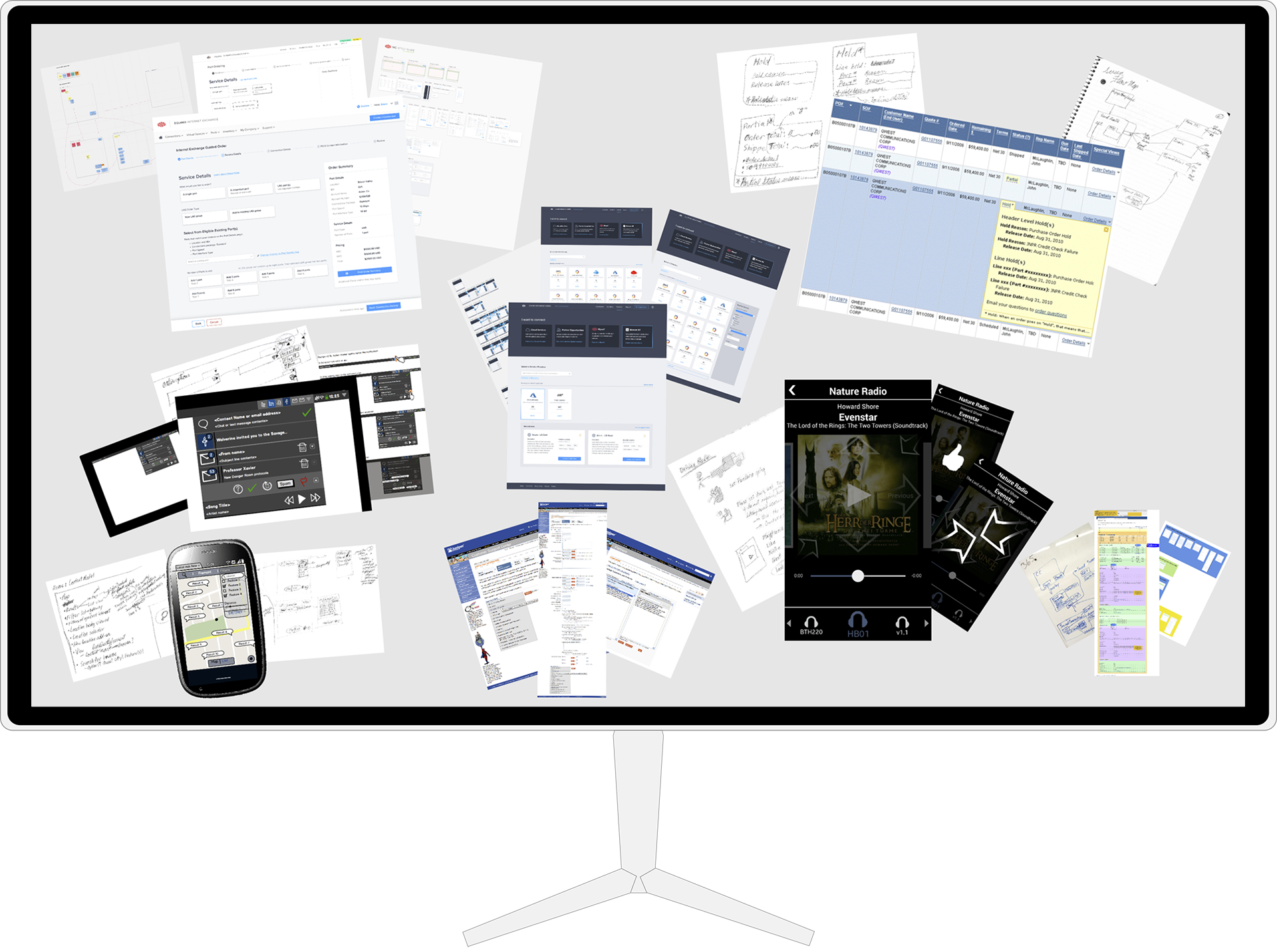
Recruited from 3 yrs on Cloud Exchange—2 as its sole designer, 1 mentoring its new designer

Reframe product strategy & set design strategy
Experience design for expanded user set & comprehensive coverage

Collaborating to implement with remote devs

A process map shows steps; it doesn't show what a process assumes.
UX asking why...
DISCOVERY
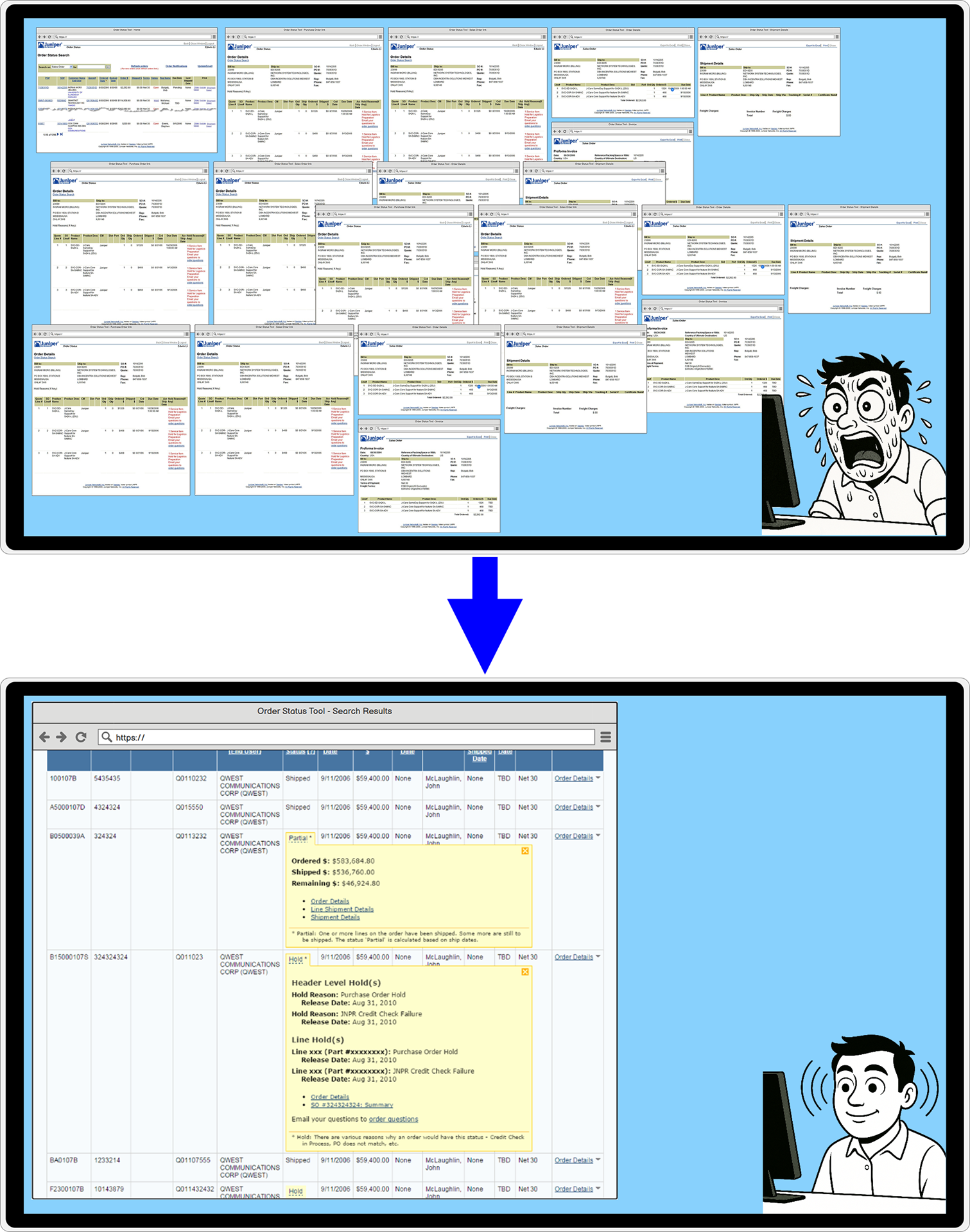
Working from our TPM's process map, I traced our 45-day average to our enterprise, white-glove mindset—a process that assumed every customer had an organization deep enough to absorb 6–8 rounds of follow-up and negotiation.

Quickly learned about IX product and the existing ordering and delivery process
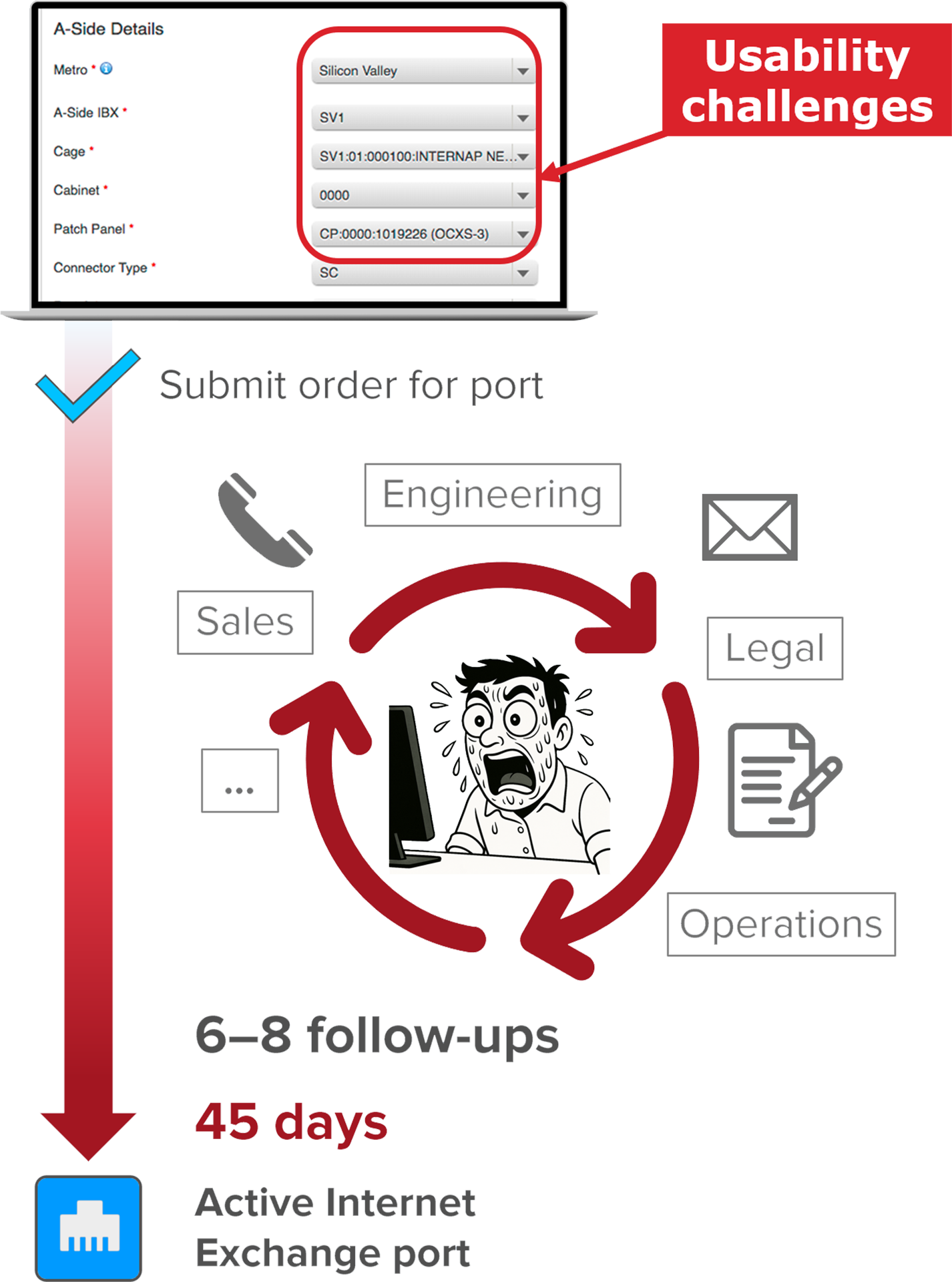

Key finding: The order form, with its usability challenges, was just the start—every department followed up separately, each needing something from the customer

It added up: Each follow-up cost days or weeks on both sides

Core opportunity: Collect a complete order up front, not just a starting point
RESEARCH --> STRATEGIC SHIFT
Comparing our process with three competitors' processes showed the speed gap was really a customer gap: they were built for buyers who wanted a transaction. So matching them meant expanding our market to SMB customers.

Competitors: less technical users

I realized competitors' designs focused on SMB and reframed our goal to "add SMB."

3 design imperatives: Clear pricing, educational content & industry-standard language, & 0 follow-ups
DESIGN STRATEGY
I established three design goals: make configuration effects visible (not hidden in dropdowns), support less technical users with in-context help, and integrate all workflows—from new country accounts to document signing—into one comprehensive wizard.

Visibility of logic, pricing, & process

Education for less technical buyers

Comprehensiveness: Integrate all ordering scenarios (including edge cases) into wizard—no post-order follow-ups
Build the structure of the task into the structure of the tool.
after Ed Hutchins' Distributed Cognition
SOLUTION: VISIBILITY & STRUCTURE
I transformed the business process map into a 5-stage wizard using tile-based selections—where configuration choices visibly affected downstream options, with pricing transparent from page one.
- Show the 5 stages in a persistent step indicator
- Progressive visibility + help: Selecting a tile reveals the next question and its options; help links embedded with the questions
- Show real-time price as customer builds order using a persistent order summary
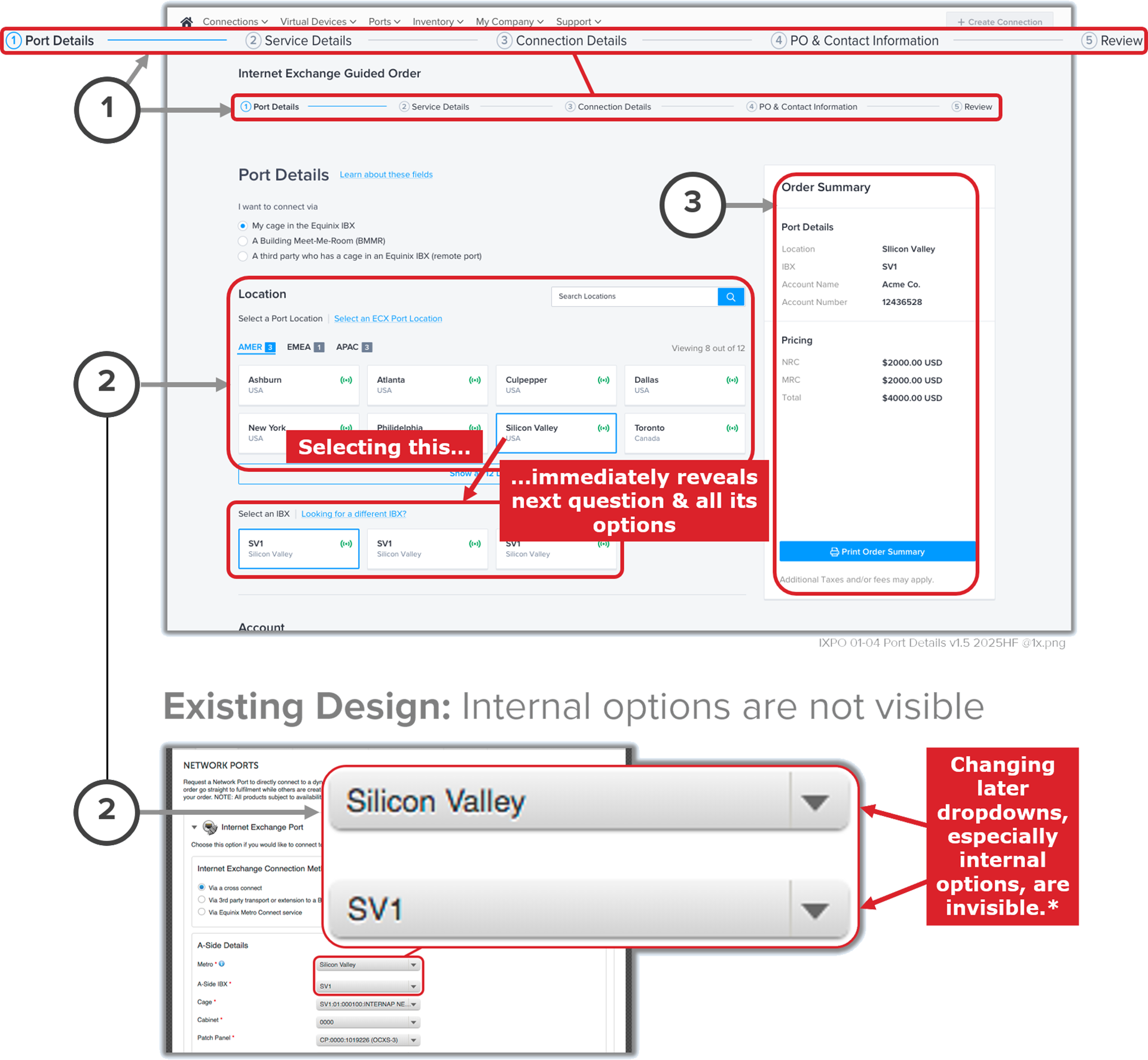
* 2cm foveal attention + heuristics from Don Norman, Jakob Nielsen, and Ben Shneiderman + distributed cognition (Ed Hutchins)
SOLUTION: COMPREHENSIVENESS
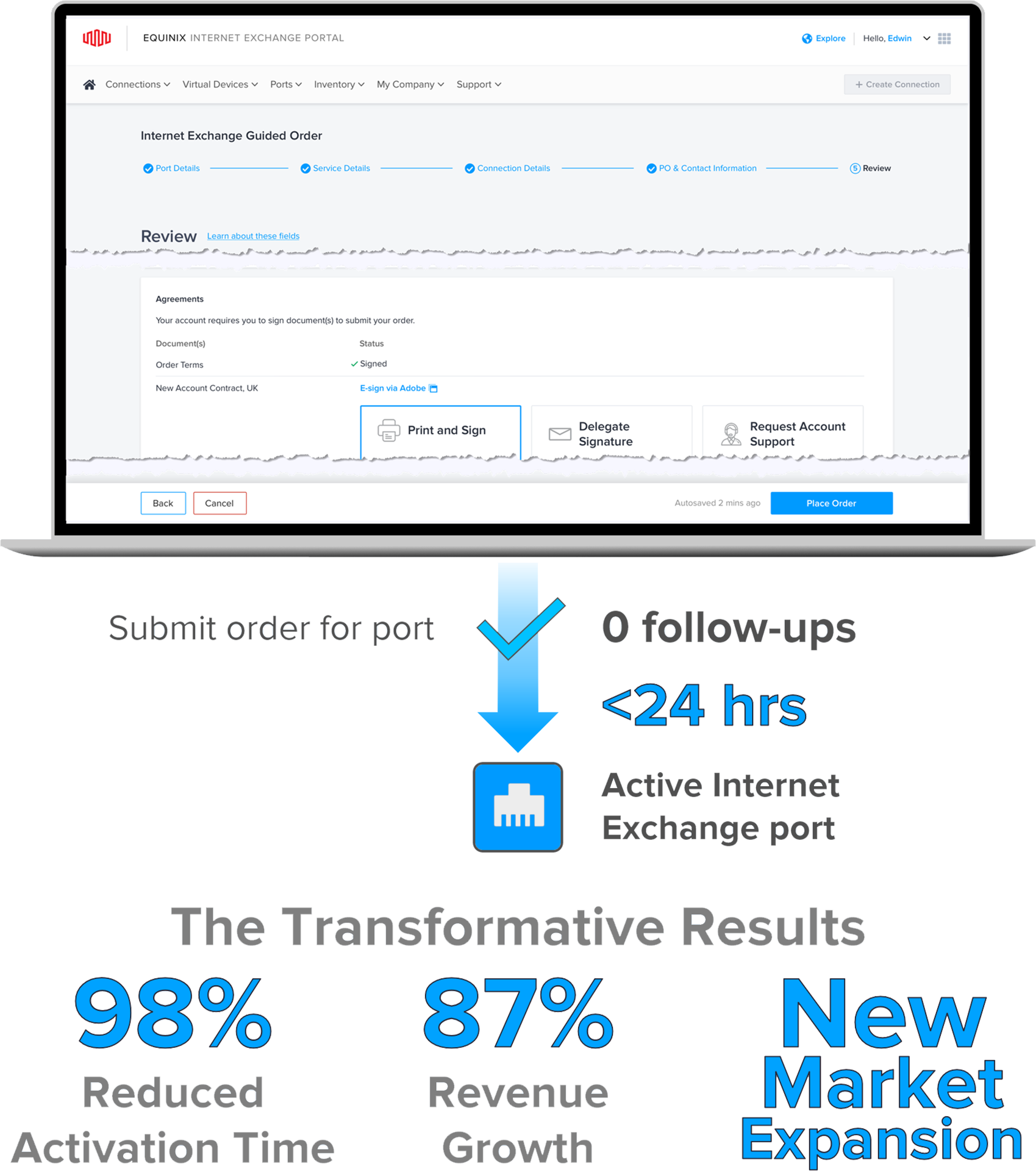
I integrated all special case workflows—new country account setup, document signing through our e-signature vendor—as embedded sub-tasks, eliminating the typical 6–8 departmental follow-ups by collecting everything in the wizard.
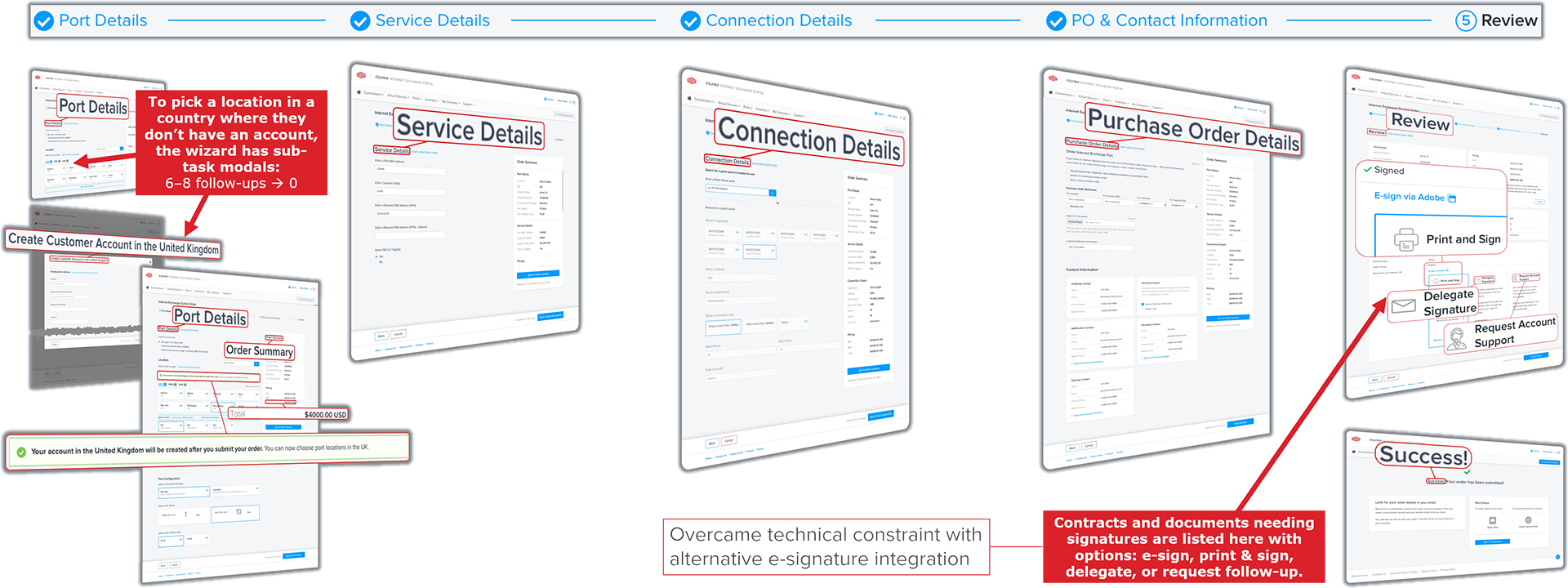
COMPONENT DESIGN → DESIGN SYSTEM
I carried the whys I'd inferred down into the components: tiles support comparison, prices stay visible, a confirmation page because SMB buyers wanted a transaction. Adopted by every IaaS product via our design system: the needs turned out to be everyone's.
- Tile expressiveness to enable at-a-glance comparison
- Added new components: enhanced step indicator for multi-page wizards, order summary, document signing tiles, order confirmation page
- Design system work: Reconciled two nascent design systems; documented patterns with both teams—which led to my next project, consolidating port ordering across products
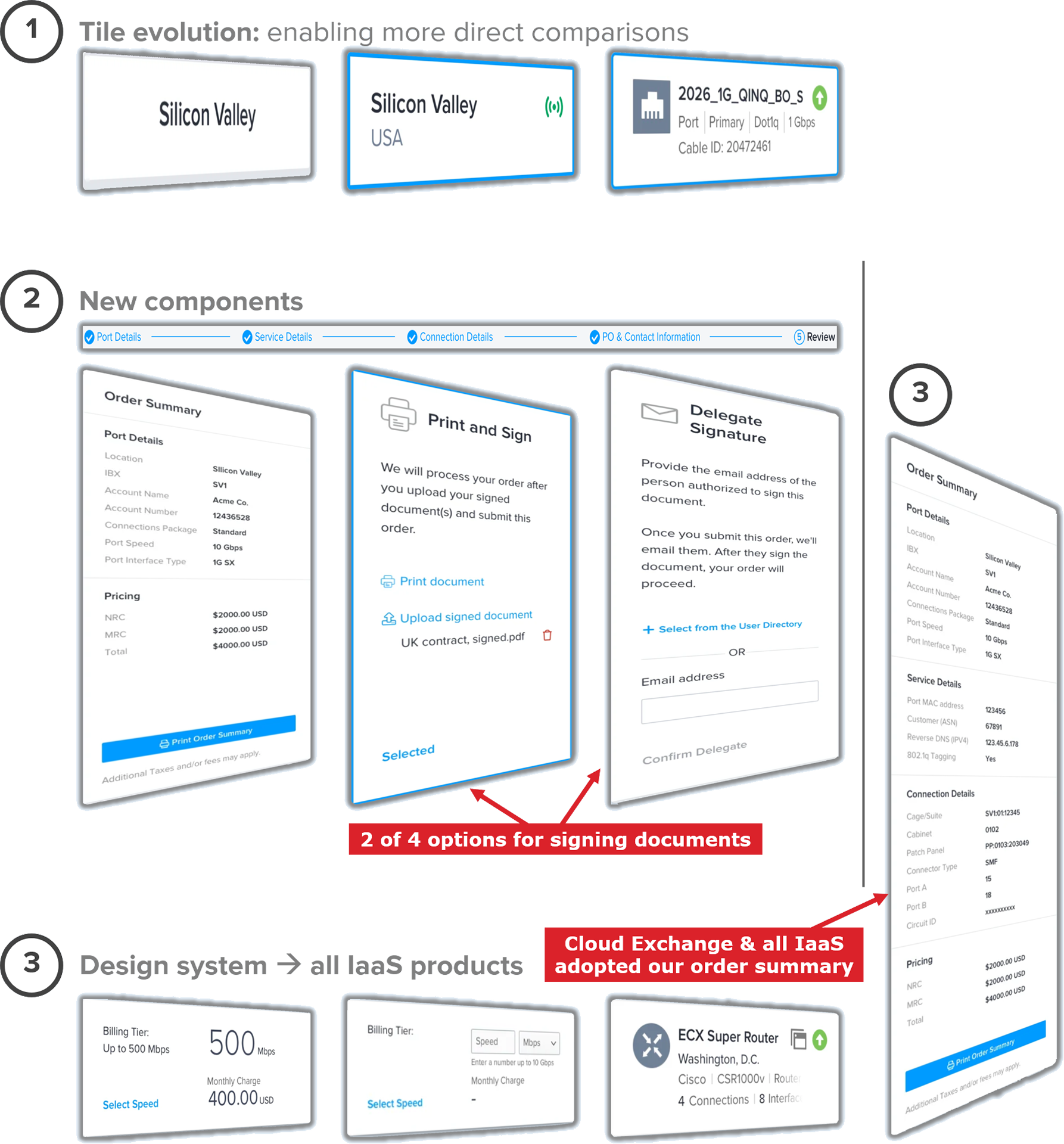
The structure of the order used to be assembled through follow-ups and negotiations. I built it into the structure of the wizard.
BUSINESS RESULTS
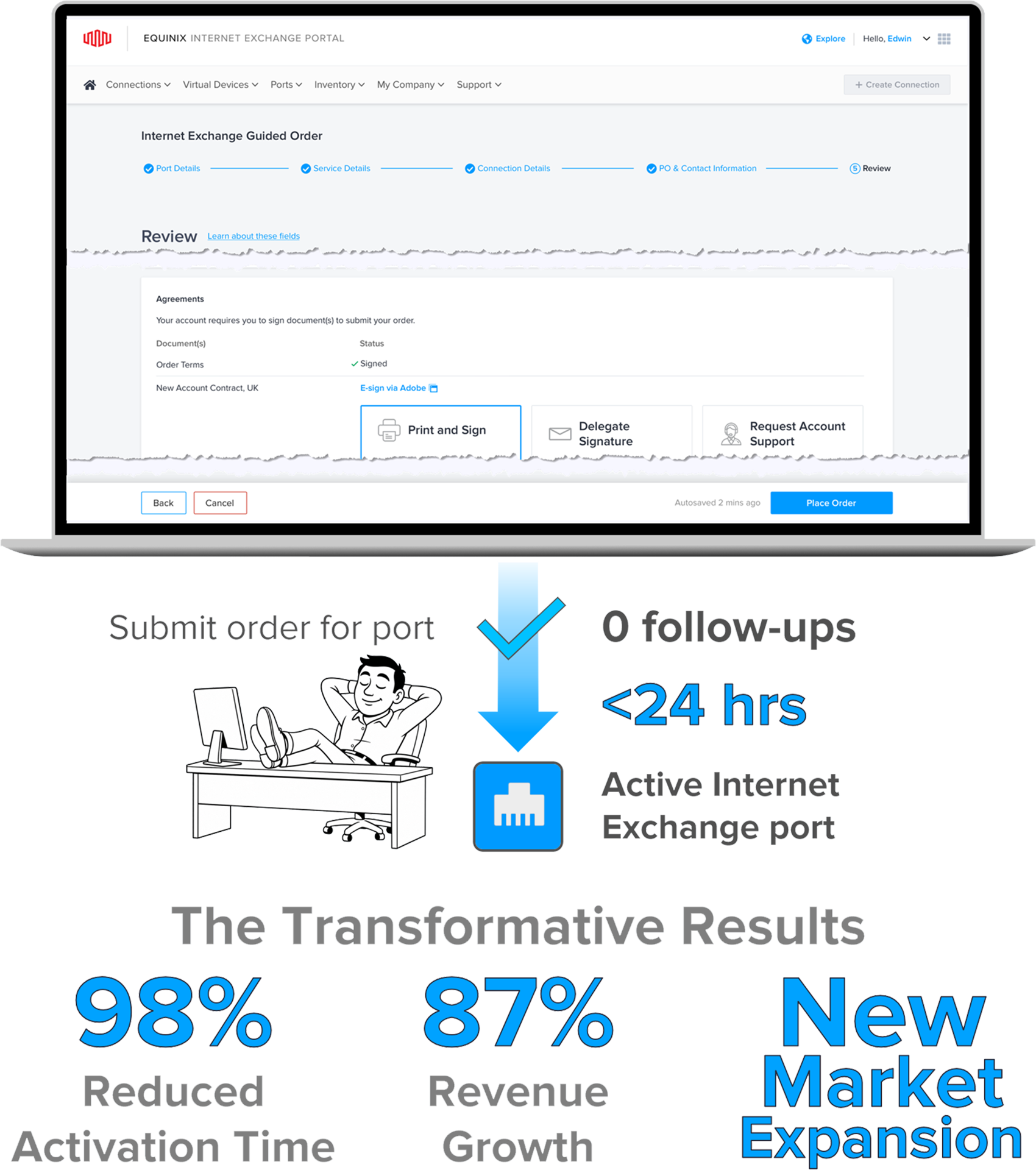
Activation time dropped 98% from 45 days to under 24 hours. Over 18 months: revenue increased by 87% to $21.7M/month & port sales by 73%—more confident customers bought both more ports and more expensive ones.
Reduced 98%
Activation time
+87%
Monthly revenue
+73%
Ports sold/month
"...activation in <24 hours"
User testimonial
Customers bought more expensive ports
Changed behavior
STRATEGIC IMPACT & LESSONS
We expanded IX's market to SMB customers through research-driven design—a strategic win beyond our 2-day goal. Next time, I'd advocate for UX involvement earlier in process mapping and Engineering discussions.

Transparency & Education Expanded Market
Research-driven design decisions (transparent pricing, educational content, visible logic) made IX compelling to SMB segment—a strategic outcome beyond the original goal—and, at the same time, gave customers the confidence to buy more expensive ports.

Foundation for future
Established the wizard template, tile patterns, and integrated workflows that went into our design system—and with it to Metro Connect, Cloud Exchange, and every IaaS product: one ordering design language across the line.

Lesson learned
Advocate to include UX during initial business process mapping, not after—would have identified gaps (new country workflow, document signing constraints) earlier and enabled architectural discussions before commitments.
- A process map records steps, and if no one in the room is asked what those steps assume about the customer, those assumptions don't get captured.
SUMMARY
98% faster activation. 87% revenue growth. Market expansion through research-driven design—a strategic win beyond our 2-day goal. Design system foundation.

Smashed original 2-day goal: The transformed 45-day high-touch process enabled a <24-hour comprehensive online experience

Strategic shift from 2-day goal to adding SMB customers: research-driven design led to expanded market, added revenue, and gave customers the confidence to buy more expensive ports

Scale of impact: Created the components and wizard template adopted by every IaaS product via our design system
"Thanks for all your efforts last year to make these flows so good they're changing perceptions of interacting with Equinix. This project is going to have a huge impact."

Product Owner, Greg Dendy
Selected Works