Tag Archives: mobile

iOS 7: First Impressions and Reactions [UX Think-Aloud 1]

iOS 7: First Impressions and Reactions [UX Think-Aloud 1]

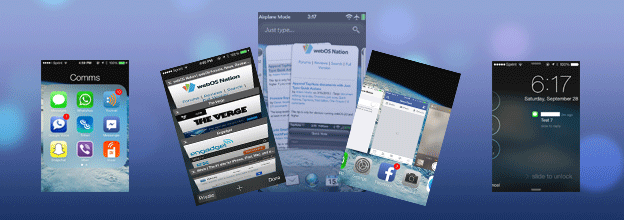
Summary: This first UX Think-Aloud article focuses on my first week with iOS 7 on my iPhone 4S, noting my impressions and reactions during actual usage after updating my iPhone 4S on September 20, 2013 (two days after it’s official release). I note UX flaws, design choices I would have made differently myself, places where the drive towards "flat design" degrades the iOS UX from its more "skeuomorphic" predecessors (e.g., unmarked text, tappable or not? Sometimes!), bugs, and more. Observations include how to get to the weather app and the new calendar widget in the Notification Center, pros and cons in the changes to the the presentation of launcher folders (one step forward and three steps back) and the most recently used app list (webOS-like, but not enough), and changes in Messages (timestamps! finally!). Certainly, iOS 7 has UX flaws and other bugs, but all OSes do. It may not be revolutionary, but I doubt iOS 7 is a death knell for its users’ ability to use their iPhones.

Continue reading →

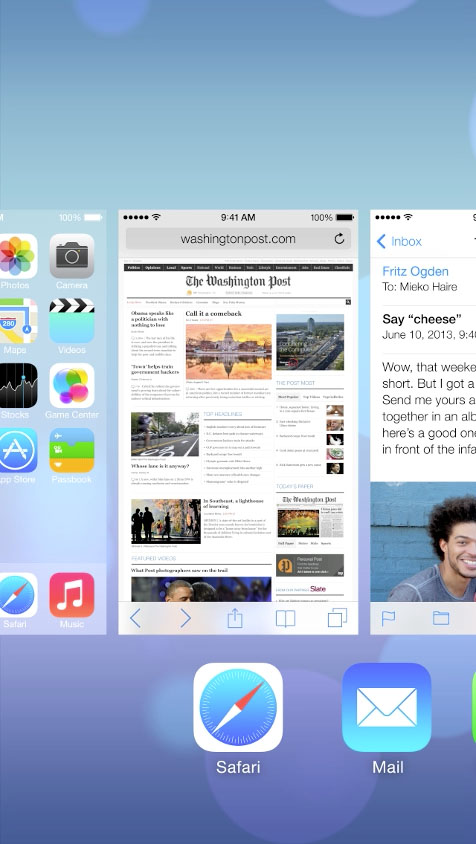
Multitasking updated in iOS 7 with new card-style interface | iMore.com

Multitasking updated in iOS 7 with new card-style interface | iMore.com.

Gyahhhh!!!! "Who needs multi-tasking?" the webOS naysayers and Apple fanboys said when dismissing webOS. Apparently, you did, and you didn’t know it, and Apple wasn’t going to be able to give it to you until four years after webOS released their first phone with it on June 6, 2009.

It appears to still require a double-tap of the Home button to invoke that multi-tasking view, a gesture that I find much more onerous than it should be given how much I want to switch between my open apps. But to dismiss a card? Swipe the card up off the screen. That latter should be familiar to anyone with any familiarity with webOS! See for yourself in Apple’s iOS 7 video–watch it from the 4:20 mark.

I’m not the only one to notice this, of course. GigaOm’s article Much iOS 7 design inspiration came from others but Apple elegantly puts it all together notes this parallel with webOS as well, though they missed the swipe-up parallel for dismissing a card.

I’m venting, and this state of affairs only brings this bitter, hilarious bit of genius back to mind (warning: video contains offensive language):

…and yes, I was in attendance at HP’s Think Beyond event to which the above video was a reaction.

Source: I first read about this on a webOS Nation Forum thread. Thanks to user virtualkyr who started that thread.

ownCloud: Could This Become An Ecosystem’s “File Stream”?

From February 24, 2013:

ownCloud is a free software suite, written in PHP, that provides file storage, synchronization, and sharing. It provides the same basic features of Dropbox or Box.net. It also provides a whole lot more.

via Meet ownCloud 5, The Open Source Dropbox | TechCrunch.

Installed on your own computer, you could have most of the benefits of Dropbox, and then some, without storage limits. Anything on your computer, available anywhere and from any device? Very interesting.

From the perspective of this connected device fantasist, if ownCloud could be extended to watch for files that have been saved, modified, or otherwise accessed anywhere in your ecosystem of connected devices and services and build a chronological and otherwise sortable and searchable representation of them, then we could have the foundation for an ecosystem-wide “File Stream”, which, by analogy to iOS’ Photo Stream, could be stream of every file you’ve touched recently (subject to options and preferences, of course), automatically making them more easily available.

This would definitely be one aspect of how my fantasy Personal Digital Infrastructure (PDI) or ecosystem of devices would serve me elegantly. It would make it that much easier to work or play seamlessly as I switch devices throughout my daily life. Hmmmm.

(Interested in ownCloud? See owncloud.org and owncloud.com.)

Disclaimer: I have no relationship with ownCloud.

Incoming Calls Shouldn’t Interrupt Video Recording on Smartphones

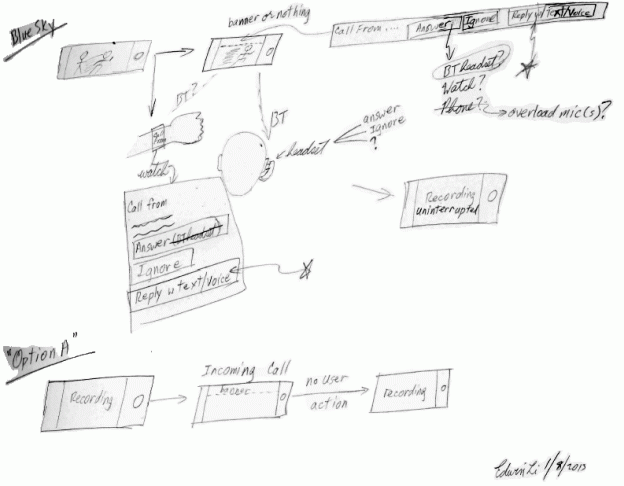
Summary: Smartphones should not interrupt users’ video recording sessions when calls come in, especially if users choose to ignore those calls, whether through inaction or via tapping “ignore” on a notification. Yet, this is what happens with the phones running the current leading mobile Oses, iOS (5, 6.1) and Android (including 4.1 JellyBean). In contrast, webOS v2.2.3 and Windows Phone 7.5 only stop recording when users choose to take the incoming call. The quick UX lesson is easy—that the latter behavior is how it should be; do not interrupt users’ activity unless absolutely necessary. The larger UX lessons include: prioritize users’ activities over system ones when possible and offer both more flexible multi-tasking and more thoughtful use of unobtrusive notifications to accommodate that prioritization.

Continue reading →

User Experience of Ecosystems

Ecosystems: Past, Present, and…

The rise of Apple’s iPod inspired the use of the word “ecosystem” in the computer industry–at the time, primarily referring to the pairing of software and hardware that was iTunes and the iPod, respectively. The use of the word, bringing with it its ecologically-based notion of complex and critical interdependence–was intended to suggest a system that should be considered together as a whole, each part contributing to the success of the rest.

Today, “ecosystem” in the computer and consumer electronics world refers to much more–smartphones, tablets, computers, accessories, computer operating systems, mobile operating systems, application stores for each of those, even developers of the software for any of those, cloud services, and web sites. Most of what is written about these things focuses on a particular piece–reviews of smartphones, tablets, computers, operating systems; the time has come to consider the next level and to actively create a vision of what that future ecosystem should look like.

User-Focused Ecosystems: Personal Digital Infrastructures (PDIs)

I believe that ecosystems should be considered in terms of user experience and actively designed as a whole to be user-focused; sure, the user experience of any particular smartphone or tablet is important, but, in a world in which each individual is potentially the owner of an increasing number of increasingly capable, networked devices, the important questions should turn from those like “how well does this device work” or “how well do these devices work together” to those like “how well can this ecosystem serve its owner in an elegantly concerted way?”

Our separate devices, software, services, data, and content should not only work together, they should work together to support their user–a sort of personal digital infrastructure (PDI) that would be an intelligent substrate enabling effortless access to all of the things we need and want in our ecosystem and seamless interoperability within it.

The user experience challenge is how to ensure that users’ ecosystems enable them to spend their time on their activities and tasks rather than wrestling with the technologies and tools they use to get those done.

Continue reading →