Tag Archives: wearables

Matias Duarte’s “Mobile is Dead” Emphasizes Designing for PDIs

In a video interview with Josh Topolsky for The Verge, Matias Duarte, Head of Design at Android, and formerly of webOS fame, said, “Mobile is dead.”

…Duarte’s point is that in an age in which users seamlessly transition from one screen size to another during their day, the idea that designers should consider mobile as a distinct category is outdated.

via Matias Duarte, Head of Android Design on the Death of Mobile — Our blog.

There’ve been a number of articles recently that resonate with this idea, and the core of it is the need for design to be more user-focused than ever, but with the expanded vision of their activities and experiences being distributed throughout their lives, days, devices, and environments.

That’s the idea behind my “Personal Digital Infrastructures (PDIs)”—which I first mentioned in User Experience of Ecosystems—and, with the forthcoming mainstreaming of wearables and The Internet of Things, it’s an idea that will only become more important.

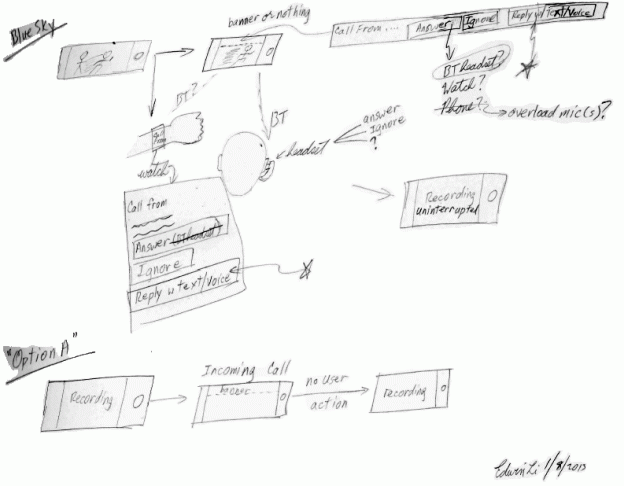
Incoming Calls Shouldn’t Interrupt Video Recording on Smartphones

Summary: Smartphones should not interrupt users’ video recording sessions when calls come in, especially if users choose to ignore those calls, whether through inaction or via tapping “ignore” on a notification. Yet, this is what happens with the phones running the current leading mobile Oses, iOS (5, 6.1) and Android (including 4.1 JellyBean). In contrast, webOS v2.2.3 and Windows Phone 7.5 only stop recording when users choose to take the incoming call. The quick UX lesson is easy—that the latter behavior is how it should be; do not interrupt users’ activity unless absolutely necessary. The larger UX lessons include: prioritize users’ activities over system ones when possible and offer both more flexible multi-tasking and more thoughtful use of unobtrusive notifications to accommodate that prioritization.

Continue reading →

Nuance’s Wintermute Could Be a “PDI-Level Property/Service”

…Project Wintermute [is] a platform agnostic voice recognition service that lives in the cloud…. intelligently saving search queries and context across platforms.

via Nuance hopes to make cross-platform voice recognition a reality with Project Wintermute | The Verge.

As a platform-agnostic personal assistant, Wintermute would be perfectly positioned to free users from vendor-delineated ecosystems. Its ability to work with multiple—in an ideal world, all—vendors’ ecosystems, would free users to use whatever ecosystems’ components they wanted, with Wintermute serving then as a PDI-level (Personal Digital Infrastructure, i.e., the users’ ecosystem of hardware, software, content, services, and social connections) service, or a property of the PDI.

Imagine: Whatever you want to use or access, regardless of whether it is beholden to iOS, Android, Windows Phone 8, webOS, or Blackberry—just talk to Wintermute, and she’ll take care of it. Not quite Jarvis1, but a step in the right direction.

1 Jarvis is the name of Tony Stark’s, a.k.a., Iron Man’s, computer in the "Iron Man" (2008, 2010) and "Marvel’s The Avengers" (2012) movies.

User Experience of Ecosystems

Ecosystems: Past, Present, and…

The rise of Apple’s iPod inspired the use of the word “ecosystem” in the computer industry–at the time, primarily referring to the pairing of software and hardware that was iTunes and the iPod, respectively. The use of the word, bringing with it its ecologically-based notion of complex and critical interdependence–was intended to suggest a system that should be considered together as a whole, each part contributing to the success of the rest.

Today, “ecosystem” in the computer and consumer electronics world refers to much more–smartphones, tablets, computers, accessories, computer operating systems, mobile operating systems, application stores for each of those, even developers of the software for any of those, cloud services, and web sites. Most of what is written about these things focuses on a particular piece–reviews of smartphones, tablets, computers, operating systems; the time has come to consider the next level and to actively create a vision of what that future ecosystem should look like.

User-Focused Ecosystems: Personal Digital Infrastructures (PDIs)

I believe that ecosystems should be considered in terms of user experience and actively designed as a whole to be user-focused; sure, the user experience of any particular smartphone or tablet is important, but, in a world in which each individual is potentially the owner of an increasing number of increasingly capable, networked devices, the important questions should turn from those like “how well does this device work” or “how well do these devices work together” to those like “how well can this ecosystem serve its owner in an elegantly concerted way?”

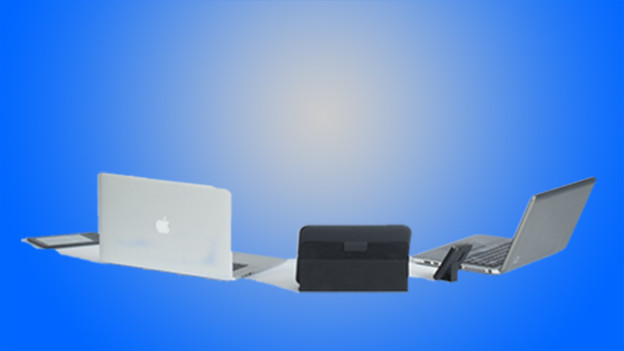
Our separate devices, software, services, data, and content should not only work together, they should work together to support their user–a sort of personal digital infrastructure (PDI) that would be an intelligent substrate enabling effortless access to all of the things we need and want in our ecosystem and seamless interoperability within it.

The user experience challenge is how to ensure that users’ ecosystems enable them to spend their time on their activities and tasks rather than wrestling with the technologies and tools they use to get those done.

Continue reading →